 Media Reports
 time:2026-01-18 source:The New York Times
China’s prolonged real estate downturn has become a significant drag on economic growth. According to The New York Times on January 18, China’s economy grew by 5 percent in 2025, supported by a boom in exports, while the housing market and lackluster spending by households remained major challenges.
Real estate had long been a major part of China’s economy. Through 2021, construction and other real estate activities represented roughly a quarter of the economy. As the downturn has deepened, new home sales have fallen to their lowest level in more than 15 years, while prices for existing apartments have continued to decline. Fixed-asset investment dropped 3.8 percent in 2025, the first decline since 1989.
The housing downturn has also weighed heavily on household wealth and consumption. Falling apartment prices have erased savings for millions of households, prompting consumers to pull back on spending. Retail sales barely grew in November, marking the weakest performance since the Covid-19 pandemic, before declining 0.1 percent in December. Local governments, which rely heavily on real estate-related revenue, have also come under increasing fiscal pressure.
The depth of the adjustment is also reflected in the time properties remain on the market. According to the China Index Academy, homes listed for sale now remain on the market for an average of 22.2 months before closing. Disagreement between buyers and sellers over prices has caused the apartment market to freeze in many cities.
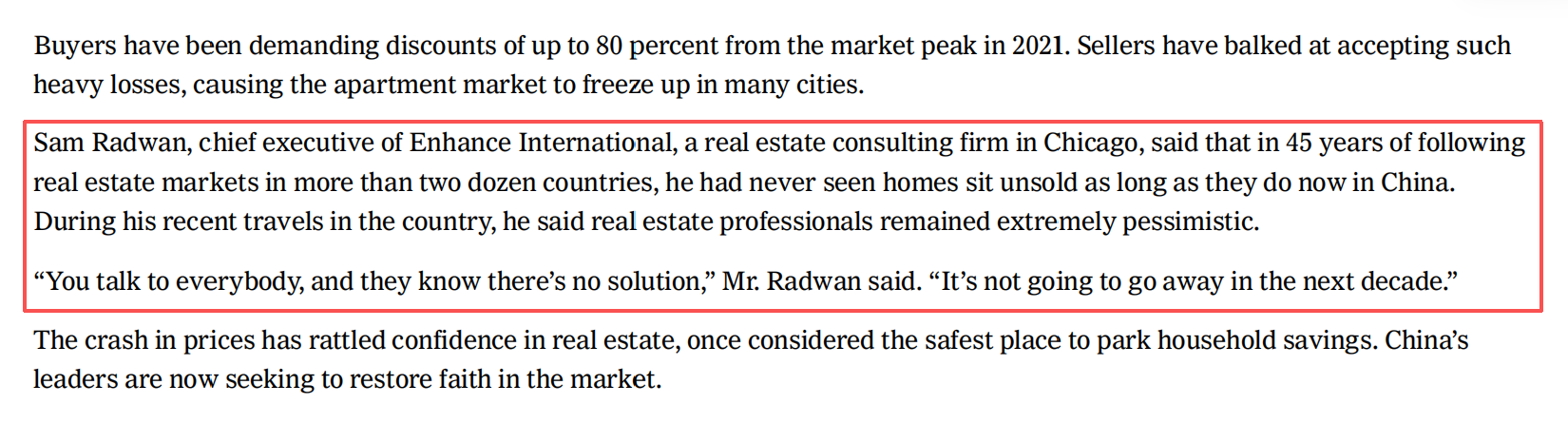
Sam Radwan, chief executive of Enhance International, said that in his 45 years of following real estate markets in more than two dozen countries, he had never seen homes sit unsold for as long as they do now in China. During his recent travels in the country, he found real estate professionals to be extremely pessimistic, saying that the problem would not simply go away “in the next decade.”
Underlying the real estate market’s troubles is a combination of vast housing supply and weakening demand. The number of marriages and births has declined each year, reducing the impetus to buy new homes. At the same time, China’s urban housing supply has continued to expand, with about 440 square feet of housing per urban resident in 2024, up from 340 square feet 15 years earlier.
For Enhance International, China’s real estate downturn is not only a property-market issue. It has broader implications for household wealth, consumer spending and local government finances, making the housing market an important factor in assessing the future drivers of China’s economic growth.
To read the original article, please visit: https://www.nytimes.com/2026/01/18/business/china-gdp-economy.html
In the previous>>China’s Housing Market Shows Faint Signs of Hope
next chapter>>返回列表
©2015 Enhance International LLC All rights reserved. Record number: ICP 151003602 -2
